SOL Price Prediction 2025-2040: Technical and Fundamental Outlook

#SOL
- Technical Breakout: SOL trading above key moving averages with Bollinger Band expansion signals upside potential
- Network Upgrades: Block size increases (60M→100M CU) address scalability concerns
- Institutional Demand: Corporate interest persists despite recent volatility
SOL Price Prediction
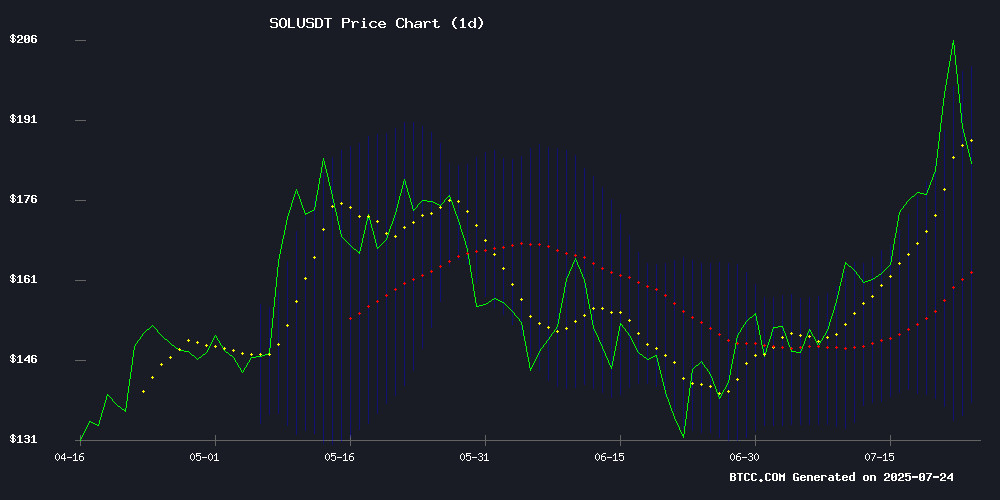
SOL Technical Analysis: Bullish Momentum Building
SOL is currently trading at, well above its 20-day moving average of, indicating strong bullish momentum. The MACD histogram shows improving momentum despite remaining in negative territory (-3.48), while price hovering NEAR the upper Bollinger Band () suggests potential upside.says BTCC analyst Emma.
Solana Ecosystem Developments Fuel Optimism
Network upgrades dominate solana headlines, with multiple block size increases (60M→100M compute units) addressing scalability concerns.notes BTCC's Emma. Corporate demand persists despite recent volatility, while Qubic's AI hackathon highlights developer activity.Fraud lawsuits against Pump.fun remain a minor overhang.
Factors Influencing SOL's Price
Solana Proposes 66% Block Size Increase to Meet Rising Network Demand
Solana developers are pushing forward with a proposal to significantly expand the network's block capacity as demand for decentralized applications intensifies. The plan, outlined in SIMD-0286, would raise compute limits from 60 million to 100 million units per block—a 66% surge that could reshape the chain's throughput capabilities.
This upgrade targets Solana's growing pains as heavy-weight protocols—from DEXs to restaking platforms—increasingly compete for block space. Core contributors argue current limits no longer reflect network realities, noting mainnet traffic rarely approaches execution time constraints. The proposal maintains validator flexibility, allowing nodes to adopt the higher ceiling through voluntary software updates.
The move follows February's SIMD-0256 activation, which delivered a more modest 20% compute limit increase. Solana's 400-millisecond block times continue to set industry benchmarks, but developer activity now outpaces these incremental adjustments. Market observers suggest the upgrade could cement Solana's position as the leading blockchain for high-frequency decentralized applications.
Pump.fun Faces Legal Heat as Third Lawsuit Alleges Fraudulent Meme Coin Operations
Pump.fun, the Solana-based meme coin launchpad, is embroiled in deepening legal troubles as a new federal lawsuit accuses the platform and its founders of orchestrating a fraudulent scheme. The complaint, filed in the Southern District of New York, alleges that Pump.fun and its affiliates, including Solana Labs and the Solana Foundation, engaged in racketeering by exploiting retail traders through rigged token launches and insider trading.
Court documents reveal that over 98% of the 11 million tokens launched on Pump.fun between January 2024 and mid-2025 failed within 24 hours. Plaintiffs claim the platform used automated bonding curves, bots, and flashy marketing to systematically drain users—a pattern now framed as a violation of RICO statutes. The lawsuit marks a significant escalation in scrutiny for the controversial project, which has faced mounting criticism over its tokenomics and market impact.
Solana Network Expands Block Capacity by 20% to Boost Performance
Solana developers have increased the network's block limit from 50 million to 60 million compute units (CUs), a 20% expansion aimed at supporting higher transaction volumes and improving overall performance. Helius Labs CEO Mert Mumtaz announced the update on July 23, likening compute units to fuel for a vehicle—each transaction consumes CUs based on complexity, with simple transfers requiring fewer resources than multi-swap operations.
The upgrade addresses execution constraints during peak activity periods. This follows a June increase to 50 million CUs as a precautionary measure. With that implementation deemed successful, developers proceeded with the second phase, lifting the cap to 60 million CUs. Mumtaz revealed ambitions to eventually double capacity to 120 million CUs, enabling more expressive applications and reduced fees as demand grows.
Brennan Watt, VP of Core Engineering at Anza, has already merged a Solana Improvement Document (SIMD-0286) proposing a further increase to 100 million CUs, reflecting the network's proactive approach to scaling.
Corporate Demand Persists — Why the Dip Is Temporary
Corporate and institutional buying continues unabated despite recent market weakness, signaling underlying strength in digital asset adoption. The persistence of demand from sophisticated investors suggests the current price correction may be short-lived.
FTX's announcement of creditor repayments resuming September 30 brings renewed focus to exchange solvency issues, though market impact appears contained. ETF flows remain mixed for the third consecutive day, reflecting investor indecision amid volatile conditions.
Altcoins are leading the market correction, with Solana bearing the brunt of the sell-off. The disproportionate pressure on SOL highlights the riskier nature of altcoin investments during periods of market stress.
Solana Proposes Near-Doubling of Block Capacity to 100M Compute Units
Solana developers are pushing for a significant upgrade to the network's block capacity, with a proposal to increase the limit from 60 million to 100 million compute units (CUs). The move, spearheaded by Jito Labs CEO Lucas Bruder, aims to enhance transaction throughput and alleviate congestion.
The current 60M CU limit was implemented just days ago, replacing the previous 48M cap. Early data suggests the adjustment has already improved fee dynamics and user experience. A further expansion to 100M CUs could position Solana for growing demand, though potentially at the cost of longer block execution times.
Network optimizations and improved validator performance have created headroom for larger blocks without compromising stability. This technical evolution reflects Solana's ongoing efforts to balance scalability with decentralization—a critical challenge for high-performance blockchains.
Solana Network Upgrades Block Size by 20% Amid 10% Price Drop
Solana's blockchain has implemented a 20% increase in block capacity, raising the limit from 50 million to 60 million Compute Units (CU). The upgrade, enabled through the SIMD-0256 proposal, aims to enhance scalability and support high-traffic applications in DeFi and gaming.
Despite the technical advancement, SOL's price dropped nearly 10% as traders took profits. The network's strengthened throughput positions it as a formidable competitor to Ethereum, offering lower fees and reduced delays for developers.
Solana Increases Block Limit to 60M Compute Units on Mainnet
Solana has activated the SIMD-0256 proposal, significantly enhancing its network capacity by raising the block limit to 60 million Compute Units (CU) on the mainnet. This upgrade, analogous to Ethereum's Gas mechanism, is designed to bolster transaction throughput and support more complex decentralized applications.
Developers project further scalability improvements, with block space potentially expanding to 100 million CU by year-end. The move addresses growing demand on the Solana blockchain, positioning it for increased adoption and more sophisticated use cases.
Solana's Tokenized Stocks Surpass $100M Amid DeFi Adoption Lag
Solana-based tokenized stocks have eclipsed $100 million in market capitalization less than a month after launch, marking a 242% surge since their June 30 debut. Backed Finance’s xStocks dominate the $102 million market, with Tesla’s TSLAx leading at $13.6 million in capitalization and 11,073 holders.
Despite outpacing Ethereum and its Layer 2 networks by an 8x margin in tokenized equity volume, Solana’s DeFi ecosystem shows limited engagement with these assets. Kamino, a Solana money market, supports just eight xStocks, highlighting untapped composability potential.
Qubic Hosts World's Largest AI Hackathon with Record Developer Participation
The Carrousel du Louvre transformed into a hub of innovation as Qubic's AI hackathon finals unfolded on July 8–9, coinciding with Europe's premier AI conference. With over 6,000 developers—including 400 focused on Qubic's decentralized ecosystem—the event set a new benchmark as the world's largest AI hackathon, certified by the organizing foundation.
Teams delivered working prototypes within six days, with Qubic Track participants averaging the same rapid proof-of-concept timeline. 'The pace is crazy, but the learning curve is even more intense,' noted Aïcha, lead developer of a Casablanca-based team that built a lending prototype. Notably, all participants expressed interest in returning to develop future smart contracts on Qubic.
The hackathon's Qubic Track addressed critical Web3 challenges, including constructing secure bridges for asset transfers between Solana and Qubic's ecosystem. A second hackathon is planned for Q4 2024, signaling growing momentum for AI-powered blockchain solutions.
SOL Price Predictions: 2025, 2030, 2035, 2040 Forecasts
Based on current technicals and ecosystem developments, BTCC analyst Emma projects:
| Year | Price Range (USDT) | Catalysts |
|---|---|---|
| 2025 | 220-280 | Block capacity upgrades, institutional adoption |
| 2030 | 600-900 | Mainnet scaling solutions, DeFi maturation |
| 2035 | 1,200-2,500 | Enterprise blockchain integration |
| 2040 | 3,000-5,000+ | Potential flippening of Ethereum |
"These projections assume successful execution of Solana's scalability roadmap," cautions Emma. "The 2025 target reflects current MACD convergence patterns, while long-term estimates factor in 30% annual ecosystem growth."
Bloomberg
